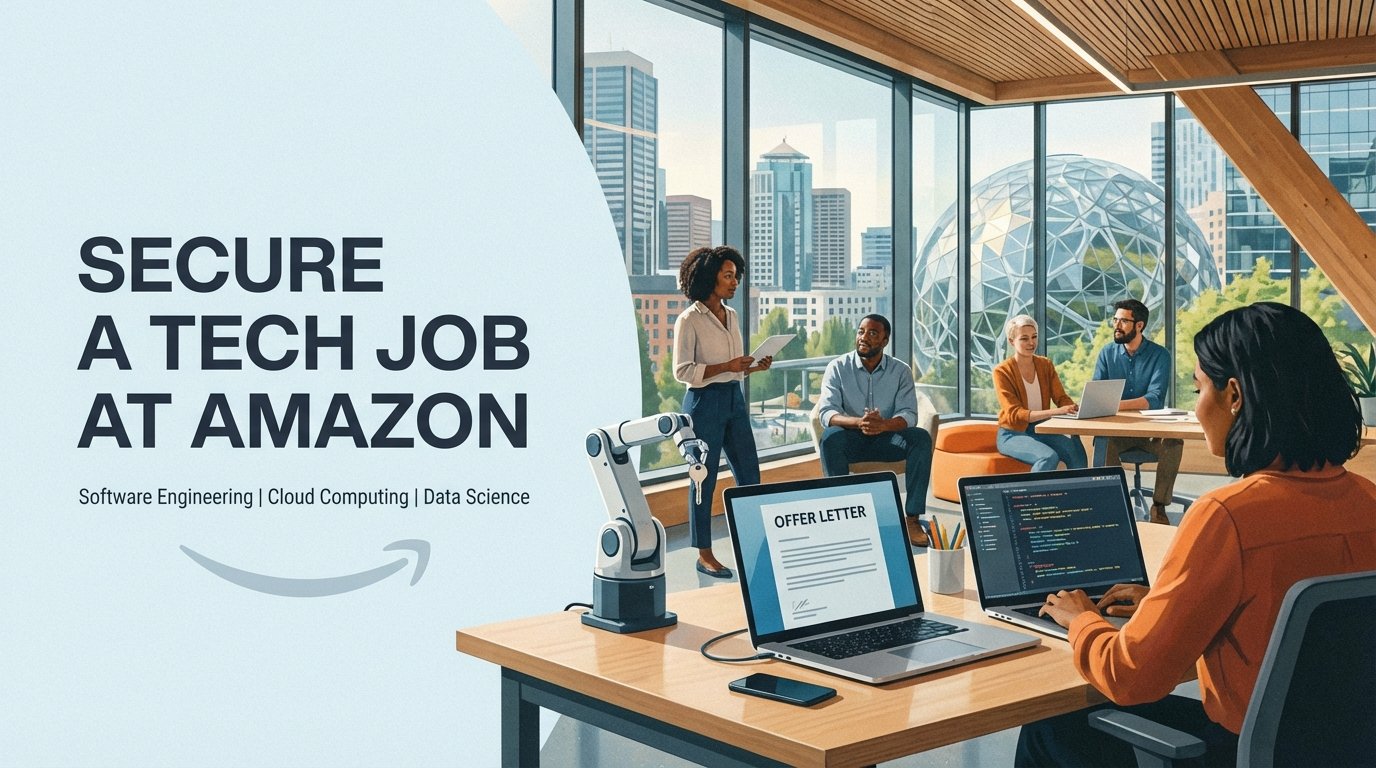

Dreaming of a tech career at a company that’s shaping the future of e-commerce, cloud computing, and artificial intelligence? Landing a job at Amazon could be your golden ticket. It’s a place where innovation happens at a staggering pace.
But getting your foot in the door is famously challenging. Amazon’s hiring process is designed to find a very specific type of person: a builder, an owner, and a customer-obsessed leader. Do you have what it takes?
This guide will break down what it truly means to pursue a tech role at Amazon, from its unique culture to the opportunities it offers. Let’s dive in and see if it’s the right fit for you.
⭐ Check These Out Too
Explore Google Roles
→
Explore Microsoft Roles
→
Explore Meta Roles
→
Explore Salesforce Roles
→
You will stay on the same website
The Amazon Ecosystem: More Than Just an Online Store
When most people think of Amazon, they picture boxes arriving at their doorstep. But behind that lies a colossal technology infrastructure that powers much of the modern internet. Amazon Web Services (AWS), its cloud computing arm, holds over 30% of the global cloud market share.
Working in tech at Amazon means you could be building the next generation of Alexa’s AI, optimizing the logistics for millions of packages, or developing new services for AWS that will be used by startups and Fortune 500 companies alike. The scale is almost unimaginable.
This isn’t just about coding; it’s about solving real-world problems that affect hundreds of millions of people. It’s a culture of “builders” who are given the autonomy to invent and simplify on behalf of the customer.
“We don’t hire people and tell them what to do; we hire smart people so they can tell us what to do. At Amazon, that means demonstrating ownership and a bias for action from day one.”
What Tech Opportunities Does Amazon Offer?
Amazon’s tech landscape is vast and varied. You aren’t limited to one type of role. The company is constantly hiring for positions across the entire technology spectrum, from recent graduates to seasoned experts.
Some of the most sought-after roles include Software Development Engineers (SDEs), who are the backbone of the company’s services. There are also Cloud Architects for AWS, Data Scientists working on machine learning models, and Technical Program Managers (TPMs) who orchestrate complex projects. The career paths are numerous, with opportunities for deep technical specialization or a move into management.
Are you more interested in a more enterprise-focused environment? It’s useful to compare Amazon’s approach with other giants. For example, our guide to Secure a Tech Job at Microsoft highlights a different corporate culture and set of priorities.
Benefits
✓Competitive pay
✓Career Choice program
✓Comprehensive benefits
✓Relocation assistance
You will stay on the same website
Why Choose a Career at Amazon?
So, why should you aim for Amazon over other tech giants? The key differentiator is the principle of “ownership.” Employees are encouraged to act like owners of their projects, giving them a level of responsibility that’s rare in companies with over 1.5 million employees.
The famous “Day 1” philosophy means the company always operates with the energy and mindset of a startup. This translates to a fast-paced environment where you’re expected to learn and iterate quickly. If you thrive on challenge and want to see the direct impact of your work, Amazon is an unparalleled arena. However, this culture isn’t for everyone. Some may prefer the more established and product-driven environment detailed in our guide to Secure a Tech Job at Meta.
General Requirements for Amazon Tech Roles
Amazon doesn’t just look for technical skills. While a strong foundation in computer science, data structures, and algorithms is non-negotiable for most engineering roles, the company places an enormous emphasis on its 16 Leadership Principles.
Can you demonstrate “Customer Obsession,” “Bias for Action,” and “Dive Deep”? Your ability to provide concrete examples of these principles in action during your interview is just as important as solving a coding problem. They look for candidates who are not just smart, but who also have the right mindset to thrive in Amazon’s peculiar culture.
This contrasts with other companies that might prioritize raw technical prowess above all. For a different perspective on hiring philosophy, see what it takes to Secure a Tech Job at Google, where data-driven decision-making is king.
You will stay on the same website
What Makes Amazon Different?
Beyond the Leadership Principles, a few things make Amazon stand out. One is the “two-pizza team” rule: teams should be small enough to be fed by two pizzas. This structure is meant to foster agility, communication, and ownership, preventing the bloat that can slow down large organizations.
Another is the writing culture. Instead of PowerPoint presentations, major decisions are driven by detailed, six-page narrative memos. Meetings often start in silence as everyone reads the memo, ensuring a deep and thoughtful discussion. This emphasis on clear writing and thinking is a core part of the job.
This internal, almost startup-like structure is quite different from companies built around a large, integrated software ecosystem. To see another successful model, explore how to Secure a Tech Job at Salesforce, where the focus is on a unified platform.
You will stay on the same website
Conclusion
A tech job at Amazon is more than just a position; it’s an entry into a culture of relentless innovation and customer-centricity. The challenges are significant, but the opportunities for growth and impact are immense. If you have a builder’s mindset, a strong technical foundation, and an obsession with solving problems for customers, Amazon could be the perfect place to build your career. The key is understanding and embodying their unique Leadership Principles.